Chat with us, powered by LiveChat How to cut ACM more efficiently in your shop.
My Cart $-.--
Shop by Category
Quick Order
0
Home At A Glantz Blog How to cut ACM more efficiently in your shop.

How to cut ACM more efficiently in your shop.

By Peggy Waters Product Spotlight
How to cut ACM more efficiently in your shop.

Aluminum Composite Material (ACM), such as beBondUSA from Glantz, has become a go-to substrate for sign shops because it’s lightweight, durable, and versatile. From exterior signage and wayfinding to displays and printed graphics, there aren’t many sign shops that don’t work with ACM.

How you cut it can have a big impact on production time, material waste, and the quality of the finished sign.

If your shop regularly cuts ACM, or you’re considering bringing more cutting in-house, here are a few things to consider when choosing your cutting method and equipment.

1. Start with a clean, accurate cut

ACM’s construction presents a unique cutting challenge. The material typically consists of thin aluminum faces bonded to a polymer core, so the goal isn’t simply to get through the panel. You’ll also want a clean, straight edge without excessive burrs or bowing.

Hand tools may work for occasional jobs, but as volume increases, a dedicated cutting system can improve both accuracy and consistency.

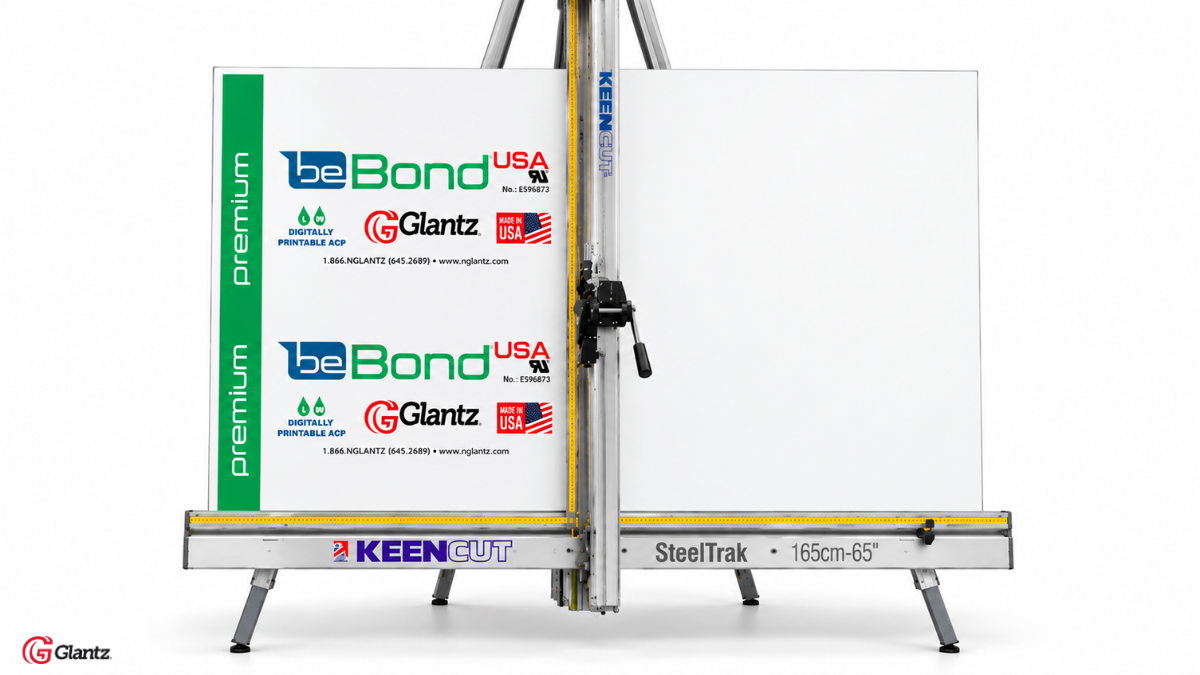
Vertical cutters such as the Keencut SteelTrak are designed specifically for sheet materials and can cut ACM while producing a finished edge that requires little or no additional cleanup.

2. Think about repeatability

Cutting one 24” x 36” sign accurately is one thing. Cutting 25 of them exactly the same size is another.

For production work, look for equipment that makes it easy to:

  • Square material consistently
  • Set repeatable measurements
  • Clearly identify the cut line
  • Hold panels securely without damaging the surface
  • Move quickly from one cut to the next

Features such as production stops, squaring arms, and integrated measuring systems can save significant setup time when producing multiple identical signs.

The Keencut SteelTrak, for example, uses production stops and a squaring arm to help shops quickly reproduce the same dimensions across multiple panels.

3. Consider what happens after the cut

The fastest cutting method isn’t necessarily the fastest production method.

If every panel needs to be deburred, sanded, or cleaned after cutting, those extra steps can quickly add up.

When evaluating a cutter, consider the entire process. Everything from loading the sheet to having a panel that’s ready for the next production step. A system that produces a clean, finished edge can eliminate secondary finishing and help move jobs through the shop faster.

4. Keep dust and debris under control

Dust isn’t just a housekeeping issue in a sign shop.

Cutting methods that create significant dust or debris can require extraction equipment and additional cleanup. Airborne particles can also be undesirable around printers and other sensitive production equipment.

Mechanical cutting systems such as the Keencut SteelTrak can cut ACM without generating the dust associated with some power-tool cutting methods. That can be especially helpful when cutting and printing operations share the same production space.

5. Watch for panel distortion

A perfectly sized panel isn’t much help if the cutting process leaves it bowed or curved.

This becomes particularly important if the material will later be run through a flatbed printer, where maintaining panel flatness can be critical.

When you’re comparing cutting methods, don’t look only at the edge. Look at the entire panel after the cut.

A good cutting process should minimize distortion and leave the material ready for its next production step.

6. Don’t overlook operator comfort

If your team makes a handful of cuts each week, ergonomics might not seem like a major consideration. If someone is cutting sheets throughout the day, it’s a different story.

Consider how material is loaded, positioned, and cut, as well as how much physical effort each cut requires.

Vertical cutters let large sheets remain upright, rather than requiring them to be repeatedly moved onto a horizontal cutting surface. The Keencut SteelTrak also uses a low-friction bearing system designed to reduce the effort required to make cuts.

For a busy production department, small improvements in each cut can make a noticeable difference over the course of a day.

7. Choose equipment that can grow with your shop

Before investing in a cutter, think beyond the job sitting in front of you today.

Ask what other materials you regularly use or may want to use in the future.

Depending on its configuration and accessories, the Keencut SteelTrak can work with materials beyond beBond ACM and can perform operations such as V-grooving ACM for trays, boxes, and displays, as well as cutting or scoring other sheet materials. It can also cut PVC board, foam board, corrugated plastic, and can score and snap acrylic without additional accessories.

That versatility can help turn a piece of equipment from a single-purpose tool into a regular part of your production workflow.

Is Cutting ACM In-House Worth It?

For shops that only need an occasional panel, ordering material pre-cut may make sense. But as your volume grows, cutting full sheets in-house can give you greater control over sizing, turnaround times, and material usage.

The important question isn’t simply, “What’s the fastest way to cut ACM?” It’s: “What cutting process gives our shop the best combination of speed, accuracy, repeatability, safety, and material utilization?”

For shops that process ACM regularly, a dedicated vertical cutting system such as the Keencut SteelTrak is worth considering.

12734_SteelTrak_CUT_OUT_1_300x300.png

If you’re evaluating cutting equipment for your shop, the Glantz team can help you compare your material sizes, applications, and production volume to determine what setup makes the most sense.

Want to cut on your own? Click here to order a Keencut SteelTrak. (Free-standing Kit sold separately.)

Need substrates cut? Glantz can help! Many of our branches offer cutting services. Click here for a list of our branch services.

Subscribe to updates
Get notified about new announcements, articles, and more!